Pirate Ships: History, Types & Famous Vessels of the Golden Age

Pirate ships of the Golden Age of Piracy could be almost any floating vessel, but the most desirable pirate ships were swift, well-armed, and nimble enough to evade counterattack. During the 17th and 18th centuries, there was no place to see a “pirate ship” already built and waiting — with the exception of certain corrupt ports in New England where a ship and a custom Jolly Roger flag could practically be arranged on demand. The best pirate ships were simply the ones most easily seized.
 The most famous pirate ships in history reflect the diversity of vessels pirates used. Blackbeard’s Queen Anne’s Revenge was a captured French slave ship, refitted with 40 guns and transformed into the most feared pirate ship on the Atlantic. Samuel Bellamy’s Whydah was a former slave galley that became the flagship of the most powerful pirate fleet in the Americas before sinking off Cape Cod in 1717 — the only fully authenticated Golden Age pirate shipwreck ever excavated. Captain Kidd’s Adventure Galley combined sails and oars in a design built for both ocean crossings and pursuit in calm seas. These famous pirate ships and their stories are woven through the history of every vessel type below.
How Pirates Got Their Ships
Acquiring a pirate ship usually meant stealing one and customizing it: removing forecastles, upper structures, and cabins for extra speed; stripping interior bulkheads for more crew space and guns; changing the mast and sail arrangement; and adding gun ports. Space was always at a premium on a pirate ship, because far more men were needed than on a typical merchant vessel — both to overwhelm enemies and to crew any prize ship taken in battle.
Careening: How Pirates Maintained Their Ships
 Pirate ships could start off in great condition, but regular maintenance was vital to keep them seaworthy. In some remote cove or river inlet, the vessel would be run aground in a way that left the hull exposed at low tide — prepared for careening. After pulling the ship over for optimum exposure, the hull was scraped clean of all barnacles, weeds, and mold. Any planks too damaged from teredo worms, rot, battle wounds, or age were replaced, and the renewed hull was coated with a layer of sulfur, tar, and tallow to slow down the sea creatures that would otherwise destroy it.
Authorities would often wait to strike until the pirates were most vulnerable during careening — when their pirate ship was out of water and their pants were around their knees.
Common Pirate Ships of the Golden Age
Pirate Sloops
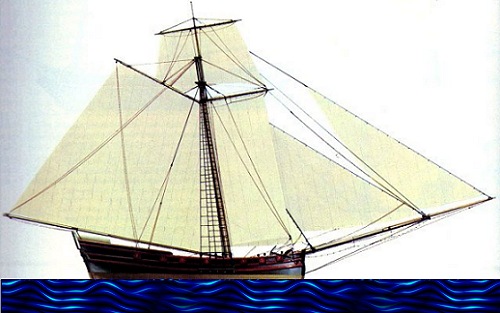
The favorite vessel of Caribbean and Atlantic pirates in the late 1600s, the sloop was first produced in large numbers by master builders in Jamaica, and its single-mast configuration was later refined by Bermudans in the 1700s. Although usually rigged for a larger fore-and-aft mainsail, it could easily be altered for various sail combinations, and the huge bowsprit added more canvas for greater maneuverability.
Thirty to sixty feet long with a top speed of over 10 knots, a crew of 20 to 70 men could work this father of the modern sailing yacht for lightning-swift attacks, avoiding broadsides, and outrunning pursuit. Despite weighing as much as 100 tons and carrying perhaps 15 cannons, its draft was amazingly shallow at eight feet — allowing it to find safety in waters far beyond any warship’s range, and making the sloop one of the most effective and feared pirate ships on the Spanish Main. (more info)
Pirate Schooners
The two-masted schooner was another of the most favored pirate ships in the Caribbean and Atlantic. Sharing many features of the sloop — terrific speed, maneuverability, and gun capacity — this swift American variant was first built in the 1700s with a narrower hull and a shallower draft of only 5 feet. This meant a pirate schooner could carry a large haul and 75-man crew further inland to hide or divide the booty, though a smaller hold stored fewer spoils. (more info)
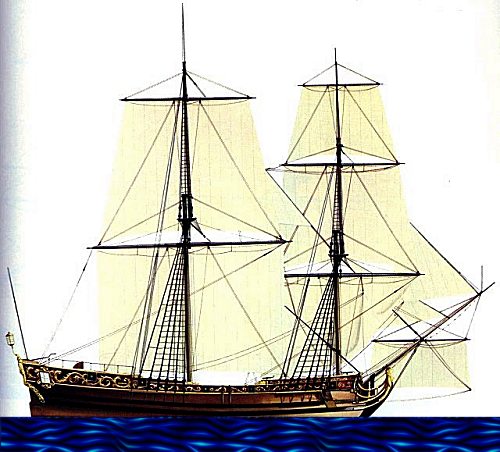
Pirate Brigantines
This shallow-draft, two-mast vessel gave terrific maneuverability and speed from its various square and fore/aft-rigged sail combinations. The brigantine was prized in the Mediterranean, where earlier versions sometimes included oars for use in diminished winds. Heavier, longer, and roomier than the smaller sloops and schooners, it was usually first choice for prolonged battles rather than quick hit-and-run raids. Adequate firepower and a larger hold also made the brigantine pirate ship a common choice for extended voyages across the Spanish Main and Indian Ocean alike. 70–80 foot length, 125–150 tons, 100+ men, 12 guns… (more info)
Square-rigged Pirate Ships & Merchant Prizes
With their large square sails hanging from arms on three masts, these were rightly called ships — the merchant vessels of the Golden Age of Piracy that pirates most loved to take as prizes. Pirates knew merchant ships were fairly slow, full of valuable goods, and under-gunned because of skinflint owners. For crossing large bodies of water some could be fairly swift for their size, but that size meant they were not agile. Owners and captains tried to compensate with more cannons, traveling in convoys, and military escorts — rarely enough to deter a determined pirate crew.
Faster— The Merchant Carrier was a 275-ton, 80-foot-long variety with a more streamlined hull. It gained a reputation for rapidly ferrying passengers and cargo across the Atlantic in a month or less. The weak point was that such a large pirate ship prize could usually carry a small crew of 20 or less, and they could rarely fire more than a few of its possible 16 guns.
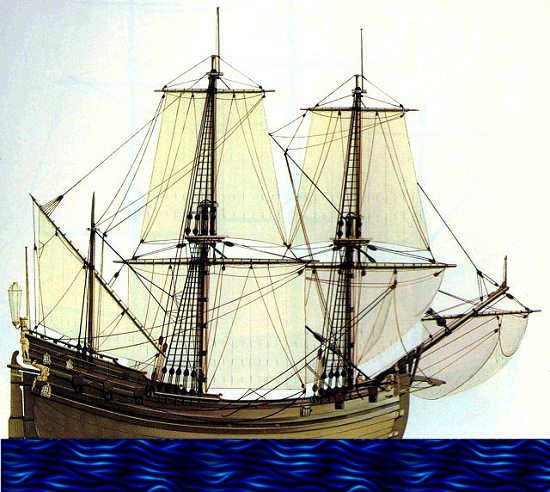
Fatter— The Dutch Fleut was so well-designed it became the prototype for cargo carriers — and a favorite prize for pirates hunting the Spanish Main. This broad, flat-bottomed ship weighed 300 tons spread over only 80 feet and could carry 50 percent more cargo than other designs. Merchants loved that the Fleut was inexpensive to build and to man, as only twelve men could make a crew. With the same weak defense as the carrier, there was no way for the crew to sail and fire very many of its twelve cannons — making it easy pickings for a well-armed pirate ship.
East Indiaman — The Ultimate Pirate Prize

Monster— An East Indiaman was by far the largest and most coveted prize of the Golden Age of Piracy. This titan was twice as large as a Fleut, weighing in at 700 tons. A pirate would spy this pregnant guppy on the horizon and get doubloon $igns in his eyes. Any East Indiaman taken as a pirate ship needed a large crew of 300 — a number possible only after successful runs in the Indian Ocean and the Red Sea, where Henry Every and Thomas Tew hunted these great ships. The top gun capacity of 54 was often reduced to make room for more loot. (more info)

Pirate Galleons & Spanish Treasure Ships
These famous Spanish-designed trade and treasure ships of the Spanish Main rejected the light defense of other merchant vessels and were truly a force to be reckoned with. No amount of cannons, however, would deter the pirates attracted to the vast wealth they carried. With a crew over 200 on two or three decks of over 70 cannon, numerous swivel guns, and even archers’ platforms on the masts, this virtual fort on water would use resistance only as a last resort — broadsides were deadly. Pirates were not swayed, because the top speed of perhaps eight knots could not overcome the irksome design features which made it impossible to maneuver well in anything less than glassy seas. With huge square sails that prevented sailing into the wind, the hull narrow at the top and broad at the bottom, and a tiny keel, it responded more like a washtub than a warship — and someone was always waiting to drain it dry. (more info)
Carrack
Predating the galleon, the Spanish and Portuguese sailed huge carracks on their trade routes. These three-masted ships were well-defended and large at over 1,100 tons — able to defend themselves against most pirate attacks. (more info)
How To Draw A Pirate Ship
Other Pirate Ships
Pirate Galleys & the Barbary Corsairs
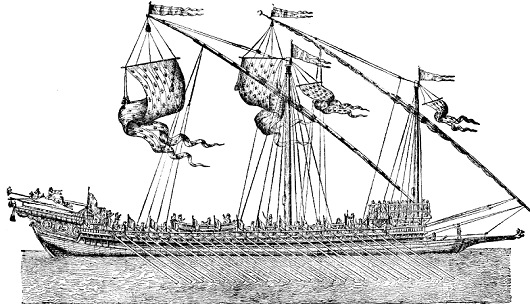 The Barbary corsairs of North Africa used a variant of this ancient, long and lean vessel during the 1500s and beyond. The sails provided only secondary power — the main propulsion came from up to 30 large oars rowed by several men apiece below the deck. One or more masts would attempt to take advantage of occasional wind with lateen sails. Corsair galley captains first employed manpower to approach their prey, then if necessary, several cannon in the bow to assault, and finally their large number of 100 or more marines to overcome the enemy.
Captain William Kidd sailed the Adventure Galley, built in England in 1695. Three masts of square sails, 46 oars, 34 guns, and a nearly 300-ton weight made it more like a frigate than a galley — one of the most distinctive and famous pirate ships of the entire Golden Age. (more info)
Chinese Junks
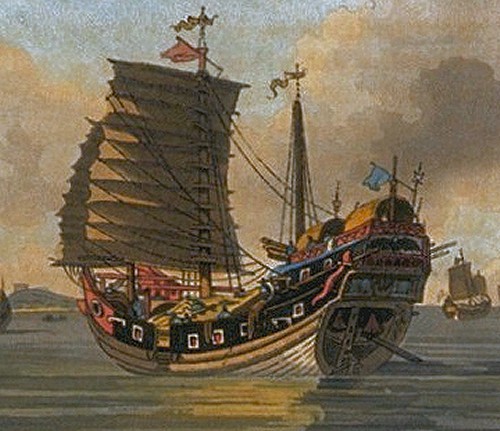
There was no other significant ship in the Far East for many centuries but the junk. Although the flat-bottom design was unimposing, it was highly adaptable to merchant, military, and pirate demands alike. Among its distinct features were a very high stern, flat bow, wide breadth, and adjustable rudder height. Chinese junks could range in size from 45 to 100 feet with two to four main masts and several heavy guns — making them formidable pirate ships in the waters off Taiwan and the South China Sea. (more info)